
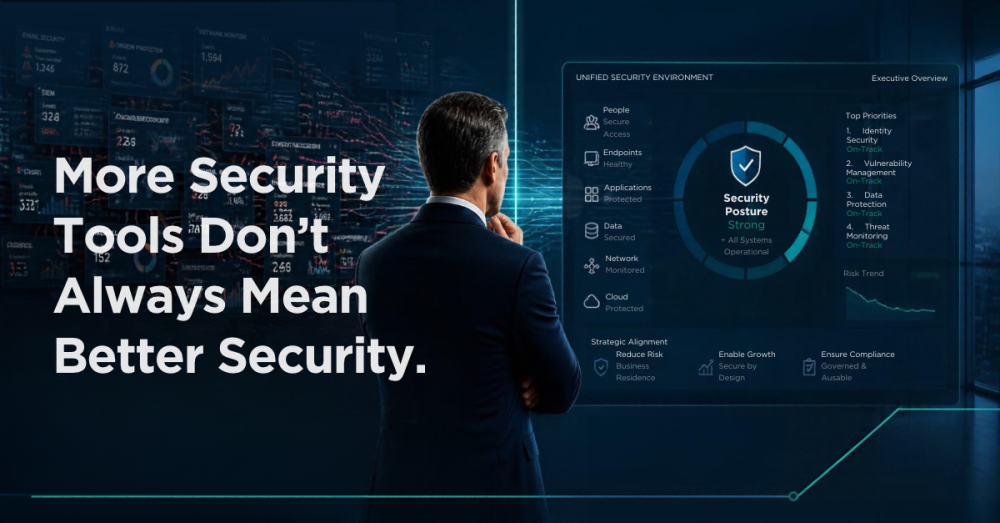
When organisations experience increasing cybersecurity pressure, the instinct is often to buy another tool.
Another monitoring platform.
Another reporting dashboard.
Another security product promising better protection.
While each investment may be well intended, more technology does not automatically create stronger security.
In fact, many organisations become less secure as their technology stack becomes more complex.
Effective cybersecurity is not about the number of tools you own.
It is about whether those tools work together to support a clear security strategy.
1. Complexity Creates Risk
Most organisations accumulate technology over time.
- A solution for backups.
- A separate security platform.
- An additional monitoring tool.
- Another product to solve a specific compliance requirement.
Individually, each solution may provide value.
Collectively, they can create complexity that reduces visibility and increases risk.
Teams are forced to move between multiple dashboards, compare different reports and manage overlapping capabilities.
When visibility decreases, security gaps become harder to identify.
2. Alert Fatigue Is Real
Security tools generate alerts because they are designed to identify unusual activity.
The challenge arises when organisations receive more alerts than they can realistically process.
As notification volumes increase, teams naturally prioritise speed over investigation.
Important alerts can be overlooked because they appear among hundreds of low-risk notifications.
Cybersecurity is not only about detecting threats.
It is about ensuring the right threats receive attention at the right time.
3. Overlapping Tools Increase Cost and Confusion
Many organisations discover they are paying for multiple solutions that perform similar functions.
This duplication affects more than budgets. It also creates uncertainty around accountability.
Which tool is the primary source of truth?
Which platform should be investigated first during an incident?
When multiple systems produce conflicting information, security teams may spend valuable time resolving confusion rather than responding to risk.
4. A Security Tool Is Only Effective If It Is Configured Correctly
One of the most overlooked cybersecurity risks is poor configuration.
A tool can be licensed, installed and operational while still leaving significant security gaps.
- Access permissions may not be updated.
- New users may not be protected.
- Critical security settings may have been disabled and never re-enabled.
The risk is rarely purchasing the wrong tool.
The risk is assuming the tool is doing what the organisation expects it to do.
Strategy Drives Security
The strongest cybersecurity environments are not necessarily the most complex.
They are the most purposeful.
Business leaders should ask:
- What are we trying to protect?
- What risks matter most to our organisation?
- Which controls already exist?
- Which tools genuinely support our security objectives?
Technology should support strategy, not replace it.
Think of your cybersecurity stack as a leadership team.
Adding more people does not automatically improve performance.
Clarity of roles, accountability and alignment create results.
Security works the same way.
Simplicity Often Leads To Better Security
Effective cybersecurity is built on visibility, governance and operational discipline.
Not software volume.
The goal should be to create an environment where tools work together, provide meaningful insights and support business objectives.
The best security stack is rarely the biggest.
It is the one that is aligned, monitored and understood.
Are your security tools reducing risk or creating unnecessary complexity?
Fuse Technology will help organisations review their cybersecurity environment, identify gaps, streamline technology investments and strengthen cyber resilience.
Request a comprehensive cybersecurity assessment
The Fuse Cybersecurity Assessment will provide you with an in-depth look at your organisation’s current cyber security posture.
We will evaluate your organisation’s ability to detect, contain and respond to threats and review your processes in place for identifying vulnerabilities within your infrastructure.