
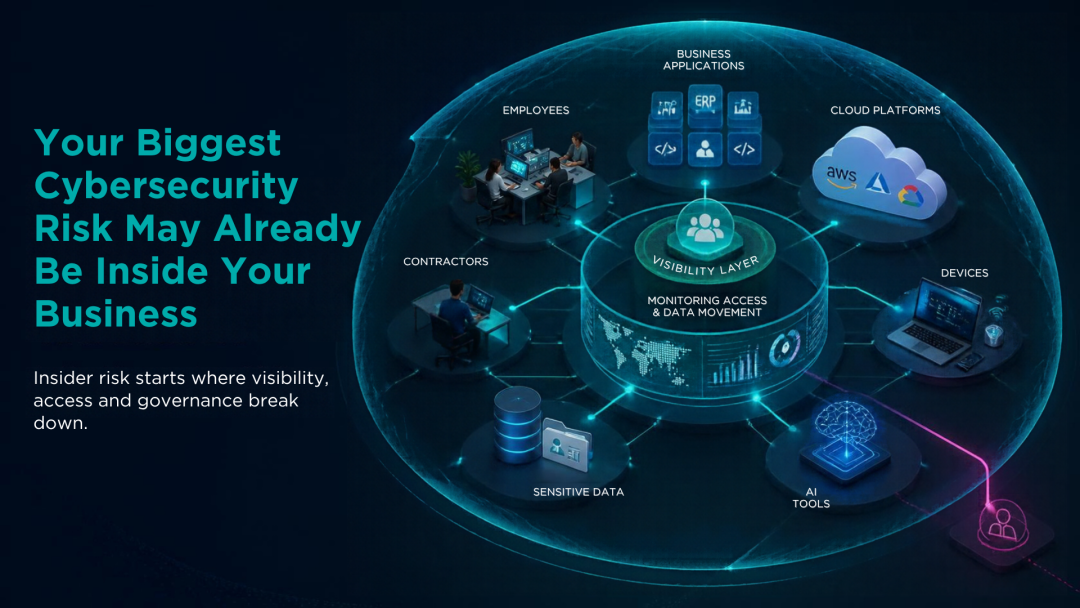
When organisations think about cybersecurity, they often focus on external threats.
Ransomware groups.
Phishing campaigns.
Criminals attempting to break into systems from the outside.
However, some of the most significant cybersecurity risks originate from within the organisation itself.
Employees, contractors, vendors and trusted partners already have access to systems, applications and business data. In many cases, they represent a greater risk than external attackers simply because they operate inside the perimeter.
This doesn’t mean people cannot be trusted. It means businesses need appropriate controls, visibility and governance to ensure access is managed responsibly.
As technology environments become more complex, insider risk has become a business challenge rather than simply an IT issue.
The Different Faces of Insider Risk
Insider threats are not limited to malicious intent. Most incidents occur because of poor processes, excessive access or a lack of visibility.
1. Data Theft
Sensitive information such as customer records, financial data, intellectual property or confidential documents can be intentionally copied, downloaded or shared without authorisation.
Whether motivated by personal gain, revenge or competitive advantage, the impact can be significant.
2. Sabotage
In rare cases, individuals may deliberately disrupt business operations by deleting files, altering systems, disabling services or restricting access to critical information.
Even a single act of sabotage can create substantial operational and reputational damage.
3. Unauthorised Access
Not every insider incident is malicious.
Sometimes employees access information simply because they can, not because they should.
When access permissions are not reviewed regularly, sensitive information can become available to people who no longer require it.
4. Human Error
One of the most common causes of security incidents is also one of the most difficult to eliminate.
- A file shared with the wrong recipient.
- Sensitive information uploaded to the wrong location.
- An email sent unintentionally.
Small mistakes can lead to significant consequences when appropriate safeguards are not in place.
5. Credential Sharing
Passwords continue to be shared far more often than organisations realise.
While it may seem convenient, credential sharing removes accountability, weakens security controls and creates unnecessary risk.
Businesses should always know who accessed a system, when they accessed it and what actions they performed.
Shared credentials make that impossible.
6. Unmanaged AI Usage
AI presents enormous opportunities for productivity and innovation.
However, unmanaged use of public AI platforms can also introduce new risks around data exposure, intellectual property protection, compliance and governance.
Many business leaders are unaware of how widely AI tools are already being used across their organisation.
The question is no longer whether employees are using AI.
The question is whether the business has visibility and control.
What Should Business Leaders Watch For?
Insider threats rarely appear without warning.
Common indicators include:
- Unusual access to sensitive information
- Large volumes of data being downloaded or transferred
- Repeated requests for elevated access
- Use of personal or unauthorised devices
- Security controls being disabled
- Unapproved AI applications handling business data
- Significant or unusual changes in employee behaviour
A single event does not automatically indicate a problem.
Patterns, however, deserve attention.
The earlier organisations gain visibility into unusual activity, the easier it becomes to reduce potential impact.
Strengthening Security From The Inside Out
Managing insider risk does not require complex technology.
It starts with strong foundations.
Implement Identity and Access Controls
Employees should only have access to the systems and data required to perform their role.
Access should be reviewed regularly as responsibilities change.
Use Multi-Factor Authentication
A stolen password should never be enough to gain access to critical systems. MFA remains one of the most effective security controls available.
Build Security Awareness
Cybersecurity is most effective when employees understand their role in protecting the organisation.
Regular education helps reduce human error and strengthens security culture.
Establish AI Governance
Create clear guidelines for how AI tools can be used, what information can be shared and which platforms are approved.
Prepare For Recovery
Backup and recovery planning remain critical. Businesses should ensure backups are secure, monitored and regularly tested.
Cybersecurity Starts With Visibility
Most insider risks are not caused by sophisticated attacks.
They emerge when organisations lose visibility over users, data, devices and applications.
Strong cybersecurity is not only about keeping threats out.
It is about ensuring the right people have the right access to the right information, for the right reasons.
The organisations that manage insider risk successfully are those that combine people, processes and technology into a clear security strategy.
Fuse Technology helps businesses strengthen access controls, improve governance and build practical cybersecurity frameworks that support long-term resilience.
Book a Cybersecurity Assessment and gain clearer visibility into the risks that may already exist inside your organisation.
Request a comprehensive cybersecurity assessment
The Fuse Cybersecurity Assessment will provide you with an in-depth look at your organisation’s current cyber security posture.
We will evaluate your organisation’s ability to detect, contain and respond to threats and review your processes in place for identifying vulnerabilities within your infrastructure.